Following on from my last blog, Ethiopia without a map … One thing I learned pretty quickly about Ethiopia is that I’d underestimated it. Instead of the parched, desolate country I’d envisaged from heartbreaking TV footage of the 1980s famine, I arrived in the north to torrential rain, ear-splitting thunder-and-lightning storms, rich red and chocolate-brown mud, vibrant green landscapes and fields carpeted in beautifully fragile yellow daisies – the Meskel Abeba.
And, while I knew Ethiopians are a kind and proud people, I hadn’t expected that I would miss their good humour when I left.
The most unexpected news, however, was the discovery that I was now seven years younger because on 11 September 2013 they’d just celebrated the arrival of 2006. In fact, everything was topsy-turvy – the Ethiopian year has 13 months, of which 12 have 30 days and one has five, and as for their baffling time system – frankly, I gave up wrestling with it. I think it starts at dawn and runs for 12 hours until dusk, so when you get up in the morning it’s about 1o’clock … but don’t quote me on that.
This blog is a jumble of anecdotes and experiences…
The trek
With news of the Kenyan shopping mall massacre still fresh and Ethiopia’s proximity to sabre-rattling borders such as Somalia, Eritrea and Sudan, I was a tad concerned that we might disturb a cave full of Al-Shabab terrorists on our trek. I was reassured by the fact that Bereket – our chilled and knowledgeable guide, fixer and friend – looked at me as if I were utterly mad when I broached it.
Nevertheless, I discovered I wasn’t the only one who was apprehensive about this adventure. It seems all six of us had last-minute nerves, not helped by Lucie’s discovery that Australian citizens are advised to “reconsider” their need to travel. At Bahir Dar we poured over contour-lines on sketchy maps and tried to convince ourselves that it was possible to cross the Simien Mountains and pick up uncharted trails to the Tekeze Dam. None of the paths or villages were marked, but we were told we’d find local scouts en route who’d know the way.
Bereket seemed laid back about it all, so that was good enough for me. He works as a freelance guide and we’d found him via a contact in a safari company in Kenya… who had put is in touch with Red Jackal Tours in Addis… who had persuaded him to wander off the map with us. “Us” being Bertie, Douggie, Marina, Stathis, Lucie and me – a melting pot of architects, artists, scientists, Greeks, Germans and Brits – and we’re friends to boot.
You might well ask why we were doing it. No-one could quite remember. I think the plan came about initially because we wanted to avoid spending too much time in jeeps or driving close to the hazardous border zones. So, instead, of doing a predictable circuit in the Simien National Park, the idea was to walk from base camp at Chenek to Hambiqo, creep over Ras Dashen (Ethiopia’s highest mountain), leave the national park and trek to tiny settlements such as Mebruq, Telba Medir and then cross into Tigray, making the final push from the Avera River to the Tekeze Dam where we’d got security clearance for the 4x4s to pick us up and whisk us to hot showers in Gheralta. But nothing ever goes quite to plan…
The trek begins – We arrived late in Chenek deep in the Simien Mountains, where we’d hooked up with our mule train and local guide to start our trek the following day. It was driving rain again and to get there the drivers of our two 4x4s performed the sort of hair-raising manoevers along treacherous mudslide precipices that you pay mega-bucks for at Mercedes World in Brooklands.
The bad news was that the tents, mattresses and sleeping bags were now soaked. The good news was that the park’s scouts sweetly bunked up so we could squeeze into their hut. Some of us were suffering the effects of the injera and local honey wine, and we were not going to see running water for another six days, but morale was… fine. We huddled around a smoky fire and ate delicious vegetable soup and pasta washed down with ginger tea. Then, cocooned in gloves, scarves and thermals, I spent the first of many freezing nights counting the hours until dawn.
Day one – Chenek to Hambiqo (8 hours) – We were high as kites. We’d climbed to 3,600 metres, discovering giant lobelias, fields of red-hot pokers, lavender, oregano, aloe vera, mint, as well as soaring lammergeyers, whole cities of placid gelada baboons, a couple of rare walia ibex on a distant crag and the most breathtaking mountain scenery with whipped cream clouds. Child-shepherds wrapped in ragged blankets or sheepskins came out of nowhere, playing flutes, shaking hands and sometimes asking for empty water bottles to recycle. We had plenty to give them as we each had to carry two litres a day.
As for the call of nature, Bertie’s thoughts of “going like a bear in the woods” were scuppered by the fact there were often no bushes, never mind woods.
We were quite a band – there were the six of us plus Bereket; our trusty national park guide; a craggy featured chap with twinkly eyes and a scarf wrapped round his head clutching an ancient-looking AK47 gun; a lively cook and his lad; and a baggage train of about six mules with their plastic-sandal-wearing muleteers. We feel overdressed in our walking boots.
Day two Hambiqo to Matbar village (11 hours). The Bradt guidebook says there are wolves in these parts, which explained the blood-chilling howling all night. The guide and Mr AK47 dismissed them as wild dogs… either way, something was making an evil snorting sound on the other side of our tiny, flimsy tent.
Frankly, it was a relief to get up at 3.45am. We had to start early to avoid the “strong sun” – although that never materialised. Clutching feeble torches and wearing as many clothes as possible, we began the freezing march up Ras Dashen, which at 4,533 metres is Ethiopia’s highest mountain. It was dark, cold, the terrain was tough and rocky and as the altitude increased my head ached and it became harder to breathe. My responses slowed, too.
While the über-fit Douggie strode ahead and bafflingly managed to sneak 40 winks in a cave, the rest of us toiled like snails up to the clouds, struggled with our personal demons and wondered aloud why the hell we were walking up a bleak, grey mountain in the middle of Ethiopia. It seems, altitude can make you emotional.
At about 11am, as I clutched feebly to a rock, nibbling some life-saving Kendal Mint Cake, our string of well-laden mules trotted past, with the muleteers wrapped in thin blankets running gamely alongside.
Half-an-hour later, we bumped into them again sheltering cheerfully under a cliff just out of the biting wind. It was lunchtime. Miraculously, the cook produced a pot of warmish pasta and vegetables, cooked at last night’s camp and we all cheered up a bit.
By now, we’d all bonded with the national park guide and grown fond of Mr AK47, who’d been using all manner of basic psychology to nudge us ever-upward. But, alarmingly, just as they’d morphed into twin Tenzing Norgays, they announced we were at the national park border, gave us the traditional Ethiopian shoulder-biff goodbye and swiftly disappeared back to Chenek.
One of the muleteers said he knew the trail for the next two days… so our lives were now in his hands. He also mentioned that he’d been “a military” during the war. As he set off at an impressive running trot, we knew it was not going to be easy.
After 11 gruelling, muscle-burning hours, we picked our way down a slope of magnificent giant lobelias and collapsed into our camp perched above one of the most dramatic, lush valleys I’ve ever seen. The agony of the day wiped away by the sheer beauty of Ethiopia and the fact we were now well off the beaten path.
BC cracked open his stash of Armagnac, Stathis broke into the nuclear-strength Ethiopian Araq and we partied until at least 8.30pm before collapsing onto our clammy mattresses.
We had to face reality, though. There’s no way we could keep walking 11 hours a day on this sort of terrain – we would need at least one more day of trekking to get to the dam. This was daunting.
The rest of the trek… We all fell totally in love with Ethiopia and its people. One of blessings of travelling rough rather than holidaying is that you get a chance to scrape the surface of a country and learn about yourself, too. Ethiopia was not set up for mainstream tourism, but we were even more off-piste than most travellers. Many children in the villages we walked through hadn’t seen white people before, but they weren’t afraid, often sneaking up to rub our skin. Everyone shook hands. Priests walked past draped in white blankets and carrying heavy crosses. We said salaam a hundred times a day.
The soaring mountains and precipices came alive with farmers and villages. On first glance you saw nothing, and then as your eyes strained you could make out the thatched rooves of round wooden huts sitting at-one in the landscape.
Our days were happy. We unearthed a roll of Gaffa Tape to patch the holes in our tiny tents. This was good news because not only did it keep the rain out, but also the insects. One of our scouts was a bit deaf and, as far as we could understand him, it was because an insect had crawled into his ear one night and burrowed deeply… it was an incentive to improvise some earplugs using tissue.
None of us got the same sleeping bag twice, but on a positive note this meant we all got a chance to use the one without a zip.
The hardest part for me was the lack of running water, which meant we couldn’t wash at all, apart from wading across icy rivers in bare feet. Nevertheless, I got used to our communal smell mingling with the scent of wild herbs and earth.
One of the villages we passed through came out in force, hoping for medicine. One woman had either leprosy or impetigo on her chin. Lucie put eye drops into a child’s weeping eye and we doled out the odd headache tablet, but we were warned about handing out too many drugs as we couldn’t explain how to use them safely.
One man we could help had ringworm. Marina had some antifungal cream, but her bag had trotted past on one of our mules long ago and we wouldn’t see it again until evening. He was unperturbed by this news. It took us another six hours to get to camp but he was already waiting for us, having taken a short cut by shimmying down a cliff face. He’d also brought us a bag of eggs, unbroken. Armed with the cream, he turned round and went back to his village in the dark.
Sitting round the fire that night I asked Bereket about the Acacia trees. They were everywhere, like giant brooding umbrellas, some with the most beautiful, yellow-scented fur-ball flowers. He told me there were more than 54 species in the country.
In fact, Ethiopia’s breathtaking scenery took us around the world. As we walked out of the Amhara region into Tigray, it was like leaving the green terraces of Thailand and entering a parched red-rock Australia.
Tigray, Tigray, Tigray. It’s a loaded word conjuring up images of conflict on newsreels. It was eerie to think this deserted land had echoed to rebel gunfire a few decades earlier. But in 2013, it was just the six of us, plus Bereket and our few muleteers, standing in a vast canyon looking up at the mountains where in hidden caves the rebels plotted their new government and the overthrow of the Derg.
More pressingly, by the penultimate day we had run out of bottled water. The last few hours of our roasting hot walk was down an empty riverbed, strewn with sharp rocks and boulders. We huddled together under a cliff face to find shade and then stumbled on again, thirsty and silent. Bereket and Lucie broke open a melon they found, but it was hard and dry.
Fortunately, that night we camped by a river in a sheltered valley which meant we could draw water and try out our mini purifier pump to fill our bottles for the final day. It was also a welcome opportunity to jump in and have our first wash in a week. There was a vague discussion about the possibility of parasites, but we were past caring. The water was warm and delicious, and we dried off before the sun set.
The next day was our last push to the Tekeze dam – a long, hot, white-dust walk that took us up one false summit after another…
And then suddenly we were there, on a narrow tarmac road that led towards the dam compound and a much-dreamed-of bottle of ice-cold beer. Unexpectedly, however, I had a strong desire to walk back into the wilderness.
One last adventure – the climb to Abuna Yemata church near Gheralta
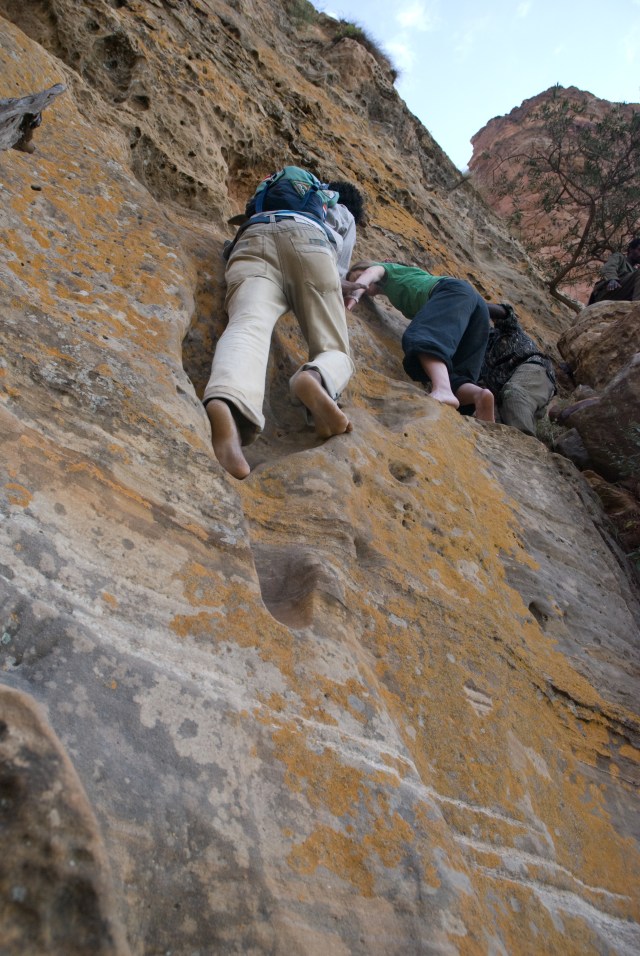
Even visiting a church in Ethiopia forces you to push the boundaries. Marina and I stunned ourselves by climbing up a sheer cliff face to the rock-hewn church of Abuna Yemata, also dubbed the church of “no rope, no hope” in guidebooks. I’m really not sure what we didn’t register about that when we took off our shoes to start the ascent.
Let me back-track. Abuna Yemata is a sixth-century church carved into a cave way up a mountain. To get there, the foolhardy have to scale a vertical rock face with only rough hand and footholds to cling on to. Someone told me the Ethiopians rely on their strong orthodox Christian faith to keep them safe. I had to rely on my ignorance of how bad it would get, and a soft-spoken local man called Tensay, who gently coaxed me to put a hand here or a foot there as we slowly climbed.
It was exhilarating and terrifying; I’m the sort of person who gets vertigo looking out of a fourth-floor window.
Having reached the sanctuary of a welcome cave, Marina and I discovered we and the guides were the only ones rash enough to try it. Our four pals were sensibly waiting for us at the bottom… We also discovered we weren’t at the church, yet. This was the baptism chapel and to get to the church, we had to step over a yawning chasm, grab onto some alarmingly brittle bits of root and negotiate a narrow sloping sandstone ledge that on one side looked down into the 200-metre void below. The view was no doubt staggering, but I didn’t dare look. By the time we got to the church door I was high on adrenalin – and very amenable to God.
We crowded in – Marina, our drivers, the very young-looking priest and our local mountain-goat-guides. I was glad to be alive.
The church was tiny, simple and awe-inspiring. Carved by hand out of the rock, the inside was decorated with saints, horses and patterns painted in vegetable dye, charcoal and blood. The only furnishings were olive-wood cleft sticks for the priests to lean on and a slightly bigger one used as a lecturn. Piled below it were goatskin boxes holding illustrated copies of the scriptures, handwritten in the ancient religious language of Ge’ez.
I didn’t want to leave – mainly because I was putting off the descent. I said a prayer to make sure we got back down safely and I was glad I did because the experience was much more terrifying than climbing up. At some point I cried. Despite the calming influence of Tensay – and Marina who was somewhere above me – I felt sure I was about to plunge to my death. Somehow, he guided my hands and feet and steadied me while also carrying my camera and clinging onto a tiny handhold himself. It was an amazing experience, but I never want to do it again.
The children We were on the long drive from Mekelle to Lalibela and had stopped to stretch our legs. As always a raggle-taggle group of children emerged out of nowhere, smiling. I gave them some of my pencils, but they didn’t seem as pleased as usual.
“What are they saying?” I asked our driver.
“They say they need clotheses,” said Mokie.
The three little boys had scrappy t-shirts and no trousers, and somehow that got me more than other sad sights I’d seen. I had no kiddie clothes, but Mokie helped me get my bag out onto the back seat and I rummaged for some big T-shirts.
“Er, Ros. Time to go I think,” said Douggie.
“Ok, give me a minute,” I said, doling out my three or four t-shirts.
“No, we need to go now,” he said more urgently.
Woah! I looked over my shoulder and saw an entire village-full of children swarming down the road towards us. All wanting clothes.
We simply didn’t have enough. There was nothing for it but to go. A sad moment. You can’t help everyone.
Ends
 RM Rosalind Mullen
Hello admin, i see your site needs fresh articles.
Daily updates will rank your site in google higher, content is king
nowadays. If you are to lazy to write unique content everyday
you should search in google for:
Ightsero’s Essential Tool