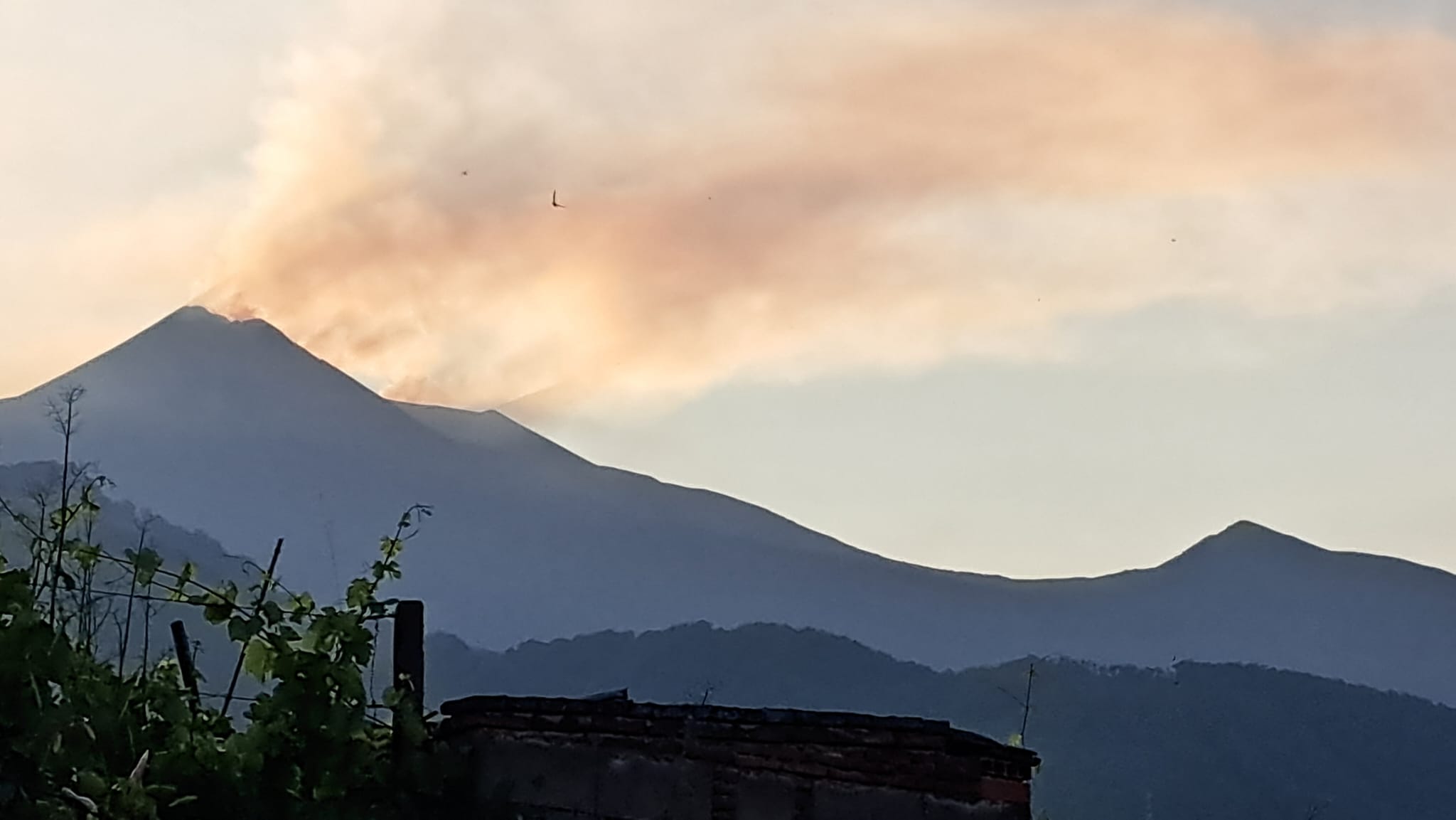
May 2025 Sicily’s Mount Etna is still puffing gently behind us, having blown its top a week ago. However, the owner of our small guest house outside Zafferana-Etnea, the small gateway town to the national park, is unfazed by the recent eruption.
“I’m relieved that it was concentrated on the north side of the volcano because we usually have to deal with a thick layer of ash over everything,” she explains to my Italian-speaking travelling companion.
The guesthouse is more of a masseria, with its own olive groves and vineyards, and it couldn’t be more peaceful. As I float on my back in the infinity pool to cautiously monitor the volcano’s puffing activity, I wonder what it must have felt like for the locals in Zafferana-Etnea in 1992 when the lava reached the outskirts of the town and the ash fallout reached over a metre high in the streets.
My husband and I are travelling with two friends, and our plan had been to take the cable car, then a 4×4 vehicle and finally a trek to get close to the active crater of the 3,350m-high volcano. In the event, with temperatures in the high 30s and the pool ensnaring our friends, just the two of us drive up to the Silvestri craters car park – about 1,986m above sea level – and explore from there.
The craters were formed after a massive eruption in 1892 but are no longer active. I attempt to get up to the higher one but am defeated by vertigo. Despite the narrow ridges and slippery slopes, I don’t see anybody else – old or young – with this problem and in fact my husband springs off ahead despite his dodgy knee. Instead, I crunch back through the dense, dry, black landscape and admire the stunning views from the smaller crater.
We had arrived at our masseria in the late afternoon the day before, having broken our journey from Catania in Acireale for lunch at La Grotta, recommended by a friend. They had closed their kitchen, but the waiters at Scalo Grande next door were about to have their own lunch and seeing our disappointment offered us what they had.
Grateful and happy, we sat at a table on the shady terrace overlooking the small harbour where small boats and swimmers magically never collided. Soon, a series of platters arrived bearing raw anchovies octopus, squid and prawns marinated in lemon and olive oil, which is Sicily’s traditional pesce crudo method of preparing seafood, similar to ceviche. There was also a bowl of local mussels, fragrant and plump. And it all slipped down beautifully with a bottle of the local chilled white wine, Etna Bianco.
After a day or two at our quiet idyll in the vineyards, the four of us tear ourselves away and take several day trips in our rather snug rented Panda, which blissfully has air-con. My favourite is Taormina, which surprises me as I expect to find it touristy and overrated. Our priority is to see the Greek theatre, so we book our timeslot ahead to dodge any crowds. In fact, it isn’t too busy – which is odd as it turns out to be the eve of Taormina Film Festival, so the likes of Michael Douglas, Martin Scorsese and scores of film buffs are in town.
The theatre itself, which could seat 10,000 in its heyday, was built by the Greeks in 300BC and modified by the Romans for gladiatorial combat. It is magical to wander through the arches and touch the ancient stones or sit quietly looking out across the bay towards distant Catania and the silhouette of the ever-present Mount Etna.
Full of awe, we treat ourselves to sundowners on the terrace of the five-star Grand Hotel Timeo, which exudes the glamour of a Grace Kelly movie. Our dry martinis cost an arm and a leg, but the superior nibbles and friendly service of the white-jacketed waiters are worth it. We sit in our wicker chairs looking across the now rosy-hued water to Etna as the sun sets.
From Zafferan-Etnea, we move south to a masseria in the hills outside Buccheri an hour north of the UNESCO world heritage town of Noto. Days are spent wandering Syracuse, Ortygia and Rafusa Iblea, immersing ourselves in pearly-coloured baroque squares and imposing duomos – or cathedrals, which were built after the earthquake of 1693 and often rebuilt after subsequent tremors.
“The baroque is almost too much,” says my friend after a few hours in Noto. But I love it. if you have ever seen the film of Giuseppe Tomasi di Lampedusa’s book The Leopard, you’ll find yourself transported back to 1860s Sicily, imagining the fading grandeur of the noble families as Garibaldi’s revolution sweeps through.
It’s hot for early June. We slip into shaded cafes to eat iced lime granitas or spend long lunches dawdling over pasta and fishy delights until the sun moves round.
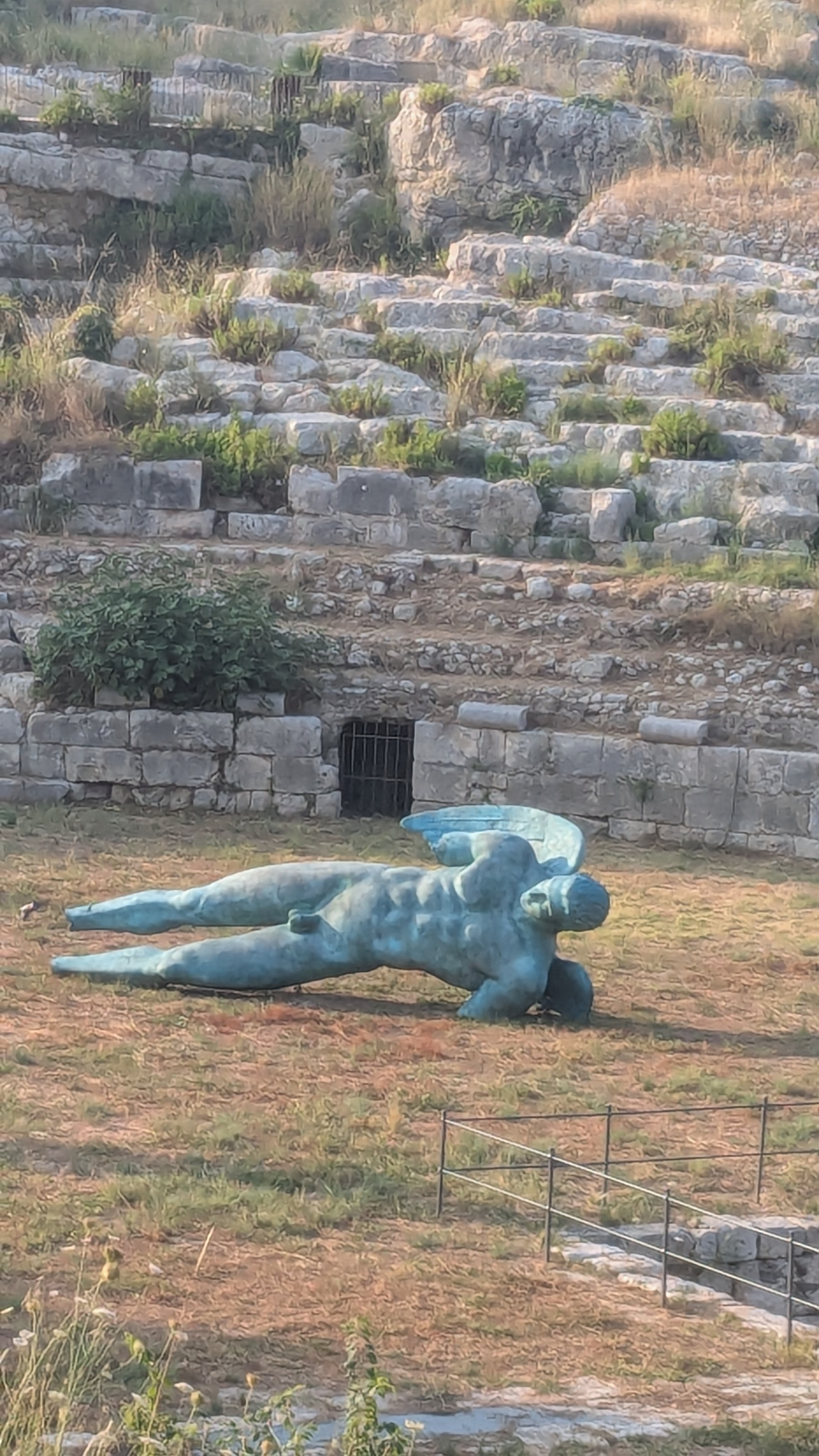
Perhaps my favourite afternoon is spent in the 200BC Roman amphitheatre and the even more ancient quarry at Syracuse’s Parco Archeologico della Neapolis where an exhibition of 27 monumental works of Polish artist Igor Mito Raj brings the human cost of its brutal gladiatorial history into sharp relief. His giant winged “Blue Ikaro” lies tragically in the arena, making me see beyond the ancient ruins to all the lives lost in that ring. Another poignant reminder is a beautiful bronze head entitled Centurion at the entrance to the arena; the sadness of his one eye haunts me.
In fact, there is too much for us to do in the afternoon we are there. For a start the 500BC Greek theatre closes early because there is a performance of Aristophones’ Lysistrata that night. We wish we had known – either to book tickets, or to sneak in before it closed.
My husband asks a young ticket collector at a gate if we can take just a quick look at the theatre. She shakes her head ruefully. I ask if we can see the quarry instead. “Yes, you can see Latomia del Paradiso,” she says, directing us down a slope through lush vegetation and lemon, oleander and pomegranate trees. At the bottom, we find ourselves in the largest of the quarries excavated in ancient times; a place where 7000 survivors of the war between Syracuse and Athens were imprisoned in 413BC.
I stand for a while, overwhelmed by the towering limestone walls, as my husband disappears into the soaring pointed grotto dubbed by the artist Caravaggio as the Ear of Dionysius. Later he reads that the Greek god built it so he could listen in on the conversations of the prisoners. Others say the grotto – 23m high and 65m deep – was dug out as a rock quarry and later used for theatrical performances.
The four of us separate, keen to make our own discoveries. I turn a corner and find two more Mitoraj figures, one winged, reflected in the still waters of a cave. Wandering further, I am pulled up short by the giant resin torso of a man incised with a cross – suitably entitled Torso Cross. The blurb says it “represents redemption … that goes beyond the Christian symbol itself”. Whatever it represents, there was something about it that made me pause and reflect.
Certainly, for those who love sculpture, The Gaze of Mitoraj: Humanitas and Physis exhibition is in the park until 31 October and is well worth visiting.
By now dusk is gathering and the park is closing for the performance of Lysistrata. As we leave for our drive back to dinner at our masseria, local families and friends are arriving to take their seats in the Greek theatre, their chatter sweeter than the braying audiences of yesteryear.