September 2023
After more than 30 years of off-on yearning, I was finally going to see the magnificent aqua-blue-green-tiled mosques and madrassas of Samarkand.
This trip had been fomenting since 1989 when I had stood in Beijing’s main train station waving some fellow backpackers off on their long journey back home to Sweden.
Their train – an ancient, rusty beast of a thing, spitting out steam and smoke – looked as if it had seen adventure. I was envious that they would be on trains like this for a month as they snaked across Asia to Moscow.
Samarkand was one of their stops. I’d already travelled to magical places on the Silk Road like Turpan, an oasis below sea level to the north of China’s Taklamaklan Desert, and had explored the ancient ruins of Jiaohe, which back then had few tourists because they were so remote. But the images I’d seen of Samarkand’s huge mosque with its soaring portals and blue domes sparkling in the desert birthplace of Timur (aka Tamburlaine) had settled in my dreams. But I imagined it was a journey that could only be done overland and would take months. At the time, there was still a lot of China that I wanted to explore and as the years passed I got distracted by so many other places.
Now, 33 years later – I was going to fly to Tashkent and take a mere four-hour journey to Samarkand on what would turn out to be one of the swishest trains I’ve ever been on. My husband, son and I sat serenely in an air-con carriage drinking tea from china cups while four hours of mostly flat, dun-coloured plains slipped by.
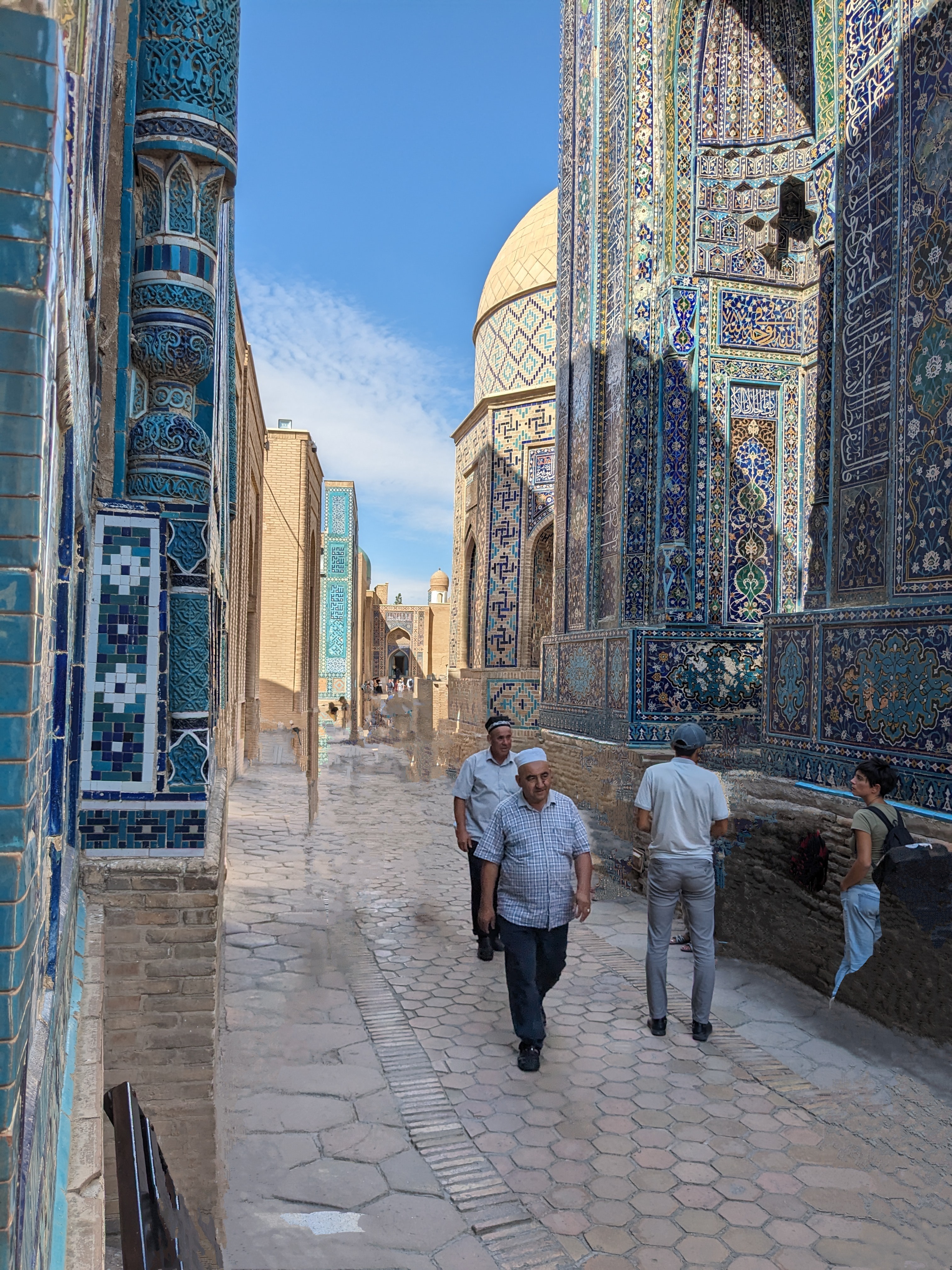
So, Samarkand at last …The Registan didn’t disappoint, even though it is now surrounded by a modern city. But I also discovered there were greater or equal beauties in the form of Timur’s exquisite jade tomb in a gilded mausoleum at Gur-i-Amir and the even more breathtaking Shah-i-Zinda where the great marauder’s female relatives are honoured in a tightly winding avenue of geometric slabs of blue and gold majolica tiled mausoleums, soaring to the sky along a narrow passageway. [continues after photo]
Then on to Bukhara…Again, we arrived by the most comfortable of trains and were greeted by a smiley taxi driver, who weaved a way for us through the throngs of travellers and hawkers, and into a narrow, dusty street. He stopped at a rusty old car with its windows half-wound down. I peered in and was amazed to see there was already a passenger onboard – a toddler in a Babygro sitting playing with a mobile phone on the back seat. I looked up questioningly.
“My baby, my baby,” said the driver showing his teeth.
“What age is he?” I asked.
“Sorry lady. Not good English.”
“How old is baby?” I repeated – though I had many, many more questions.
“Two. Baby is two,” he said as he held up two fingers.
I slipped uncertainly into the seat next to Baby, while my husband took the other side and my 6ft son squeezed into the front. Baby, who was not in a child seat and didn’t have a seatbelt, ignored us.
“I don’t think we can put our seat belts on if the child hasn’t got them,” I mumbled to my husband.
“I’m putting mine on,” he said determinedly. “The Dad has got one on. And have you seen the driving round here?”
Whoosh! Suddenly we were off and lurching out into the traffic, swinging from side to side at speed, while Baby rolled between us mutely playing on his father’s phone. Every now and again Dad reached back to take the phone to make calls while careering through the crazy traffic.
The three of us sat silently. I couldn’t take my eyes off the rolling Baby, while the other two stared out at the traffic in terror.
“That was odd,” my son said when we were finally deposited at the guesthouse.
“Really odd,” I agreed as we watched the taxi motor off bumpily down the alleyway with Baby still on the backseat – now no longer safely wedged between my husband and I.
We deposited our bags and asked the guesthouse owner how best to get to Chor Bakr, a mausoleum complex with one or two tombs dating back to the 10th century – rare, as Genghis Khan seemed to have destroyed nearly everything when he arrived in the 12th century.
“I get you a taxi,” said the owner, “too far to walk and no bus.”
It was with some astonishment that when the car eventually drew up next to us, I saw a sweet little face on the back seat.
“It must be the same bloke,” said my son incredulously.
“No. It’s a different baby. And a different driver,” said my husband staring through the window.
We both wedged the little guy in as before.
“How old?” I asked.
“Baby is three,” said Dad happily. “My baby.”
“You look after Baby today?” I asked.
“No understand. Sorry,” said the driver.
“Must be “bring your child to work” day,” said my son, folding his legs into the front seat.
I smiled at the little boy, who was wearing spotless shorts and a t-shirt and amused himself by tipping sticky orange tic-tacs into his hands and then putting them all back. Like the child before, he didn’t utter a word. In fact, there was no interaction with us at all. No curiosity. He completely ignored us. I worried that he was actually terrified of us.
And I think he was. Until he spilled his tic-tacs, that is. I helped him to gather the sticky orange tablets – which I realised he had already half-sucked – and was rewarded with a mute, polite wave when we said goodbye at our destination.
“That really is odd. They are so solemn and well-behaved, these kids,” I said, trying to imagine that scenario in the back of a London taxi – or even a friend’s car.
“Yes. The dad must drum it into them about not bothering the customers,” my husband suggested.
“But why are these babies there in the first place?” said my son.
Later, I asked a guide who spoke good English why we had experienced travelling with two babies on the back of a taxi seat in the space of a few hours – and in the same city.
“Oh,” she said. “Many taxis provide a service to pick up the child from school.”
“But they were babies… toddlers – the drivers’ babies,” I said. “Not schoolchildren.”
She looked irritated and changed the subject. “Here we have the Maghoki-Attori mosque that was buried in sand by the locals to protect it during the Mongol invasion…” she said, moving in front of me.
It seemed I was not going to get to the bottom of this babies-in-taxis thing, but it struck me that it could simply be how husbands and wives in the city split childcare arrangements.


 RM Rosalind Mullen